







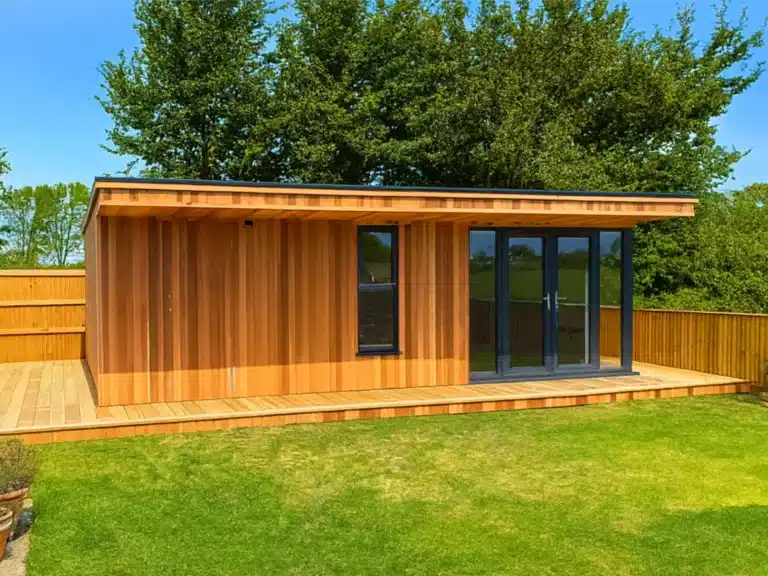
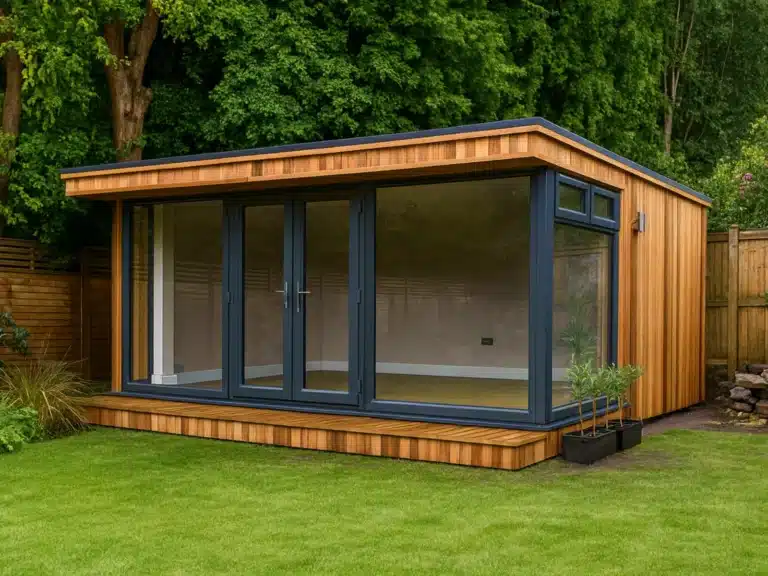
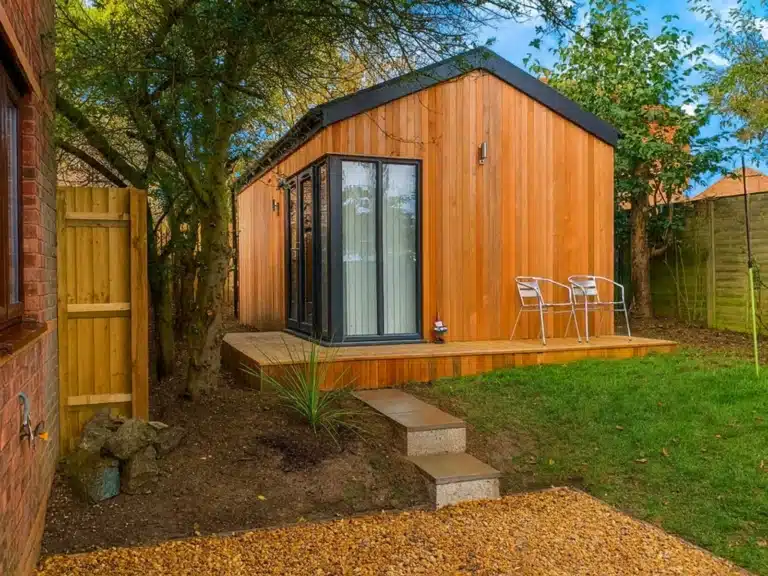
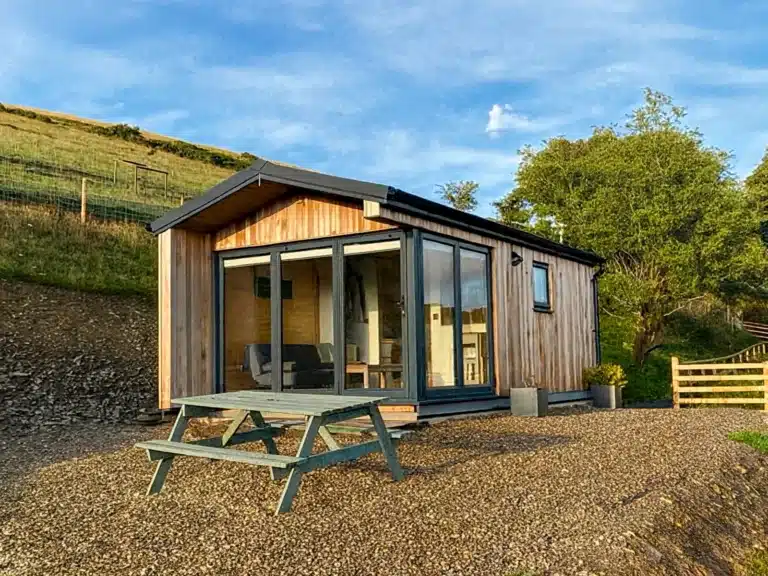



Many people considering a garden room are sometimes worried about potential noise issues. If the garden room is sited near neighbouring properties, they might be concerned that relatively thin walls might not offer the same kind of soundproofing as the home. This could mean that music, TVs or simply conversation could travel, be intrusive or compromise their own privacy.
The construction and materials used in a modern garden room mean that they all offer some resistance to sound transfer, but this isn’t comprehensive. Extra soundproofing can be added to create a completely soundproofed garden studio.
At Garden Room Sanctuary, we regularly construct soundproofed garden music rooms and studios for our customers.
Sound insulation in Garden Rooms
In most buildings, walls and floors have a support structure of steel, wood, joists or studs. These are then covered with plasterboard or another form of rigid sheeting. This creates an air space between the ceiling and floor. This air space allows for the easy transfer of sound waves with little in the way of solid mass for the sound to vibrate through, and slow down. Insulation in this space will reduce the transfer of sound by removing the air space, but it won’t prevent sound transfer through plasterboard, joists, studs and flooring.
Sound waves will vibrate the plasterboard if it\’s nailed directly to wall studs. This then transfers to the studs and onto the external plasterboard. These sound vibrations then transfer to the air in the external room and become sound waves again. This process is known as ’ coupling.
Another reason why insulation alone cannot be relied upon to provide complete soundproofing is that sound frequencies travel differently. Insulation won’t block out low bass frequencies, and it will only have a partial dampening effect on higher frequencies. Insulating the dead space in a building will only really prove effective against mid-range frequencies. This means that if you intend to play music at reasonably high levels, the bass and higher frequencies are likely to travel.
As many people like to use their garden rooms either to practice an instrument, record their own music, or to simply listen to their music collection, what can you do to prevent your hobby from becoming a nuisance to your neighbours?
De-Coupling
A simple technique to enhance the soundproofing of a garden is decoupling. This creates a space between the drywall and the studs. This reduces the vibration and the resulting transfer of sound significantly. One means to achieve this is to add a resilient rubber cushion between the studs and the plasterboard to help absorb the vibrations.
Another method is to install a cushioning sheet under the drywall, but over the stud wall, or over floor joists and under sub-flooring. Both these methods help to reduce the transfer of sound, whatever the frequency.
Extra Measures
It’s possible to add further soundproofing measures that can almost eliminate sound transfer when used in conjunction with basic soundproofing techniques. Acoustic triple glazing, noise lock doors and sound isolating shutters can all give a building very high levels of soundproofing.
Bespoke soundproofed garden music room
Soundproof garden rooms come in a variety of possible specifications, featuring varying ranges of sound insulation. If you want to use your garden to practice a non-amplified instrument, a basic acoustic installation should be enough to reduce the amount of sound transfer. If, however, you\’re imagining band practices or a music recording studio, then you will probably want to employ extra elements.
A soundproofed garden room will make use of a range of techniques, depending on the particular acoustic specification required and your intended use. It\’s not just the specification that needs to be considered, however. The layout of a garden room will impact the levels of sound transfer that take place. If you want to create a soundproof room, you will typically limit the number and size of the windows and doors used. These all leak sound, so the fewer you have, the easier it will be to create a truly soundproofed space.
A bespoke garden room will balance your specific requirements and the need for sound insulation with aesthetic considerations.
The experienced team at Garden Room Sanctuary can help you create the perfect soundproofed garden room. To learn more about our approach and to discuss your ideas, contact us by using our online form.